Bandwidth Allocation Strategies for Prioritizing Audio Clarity Over Visual Fidelity in Remote Cooperative Play Sessions
Carlo Long · Nov 5, 2026
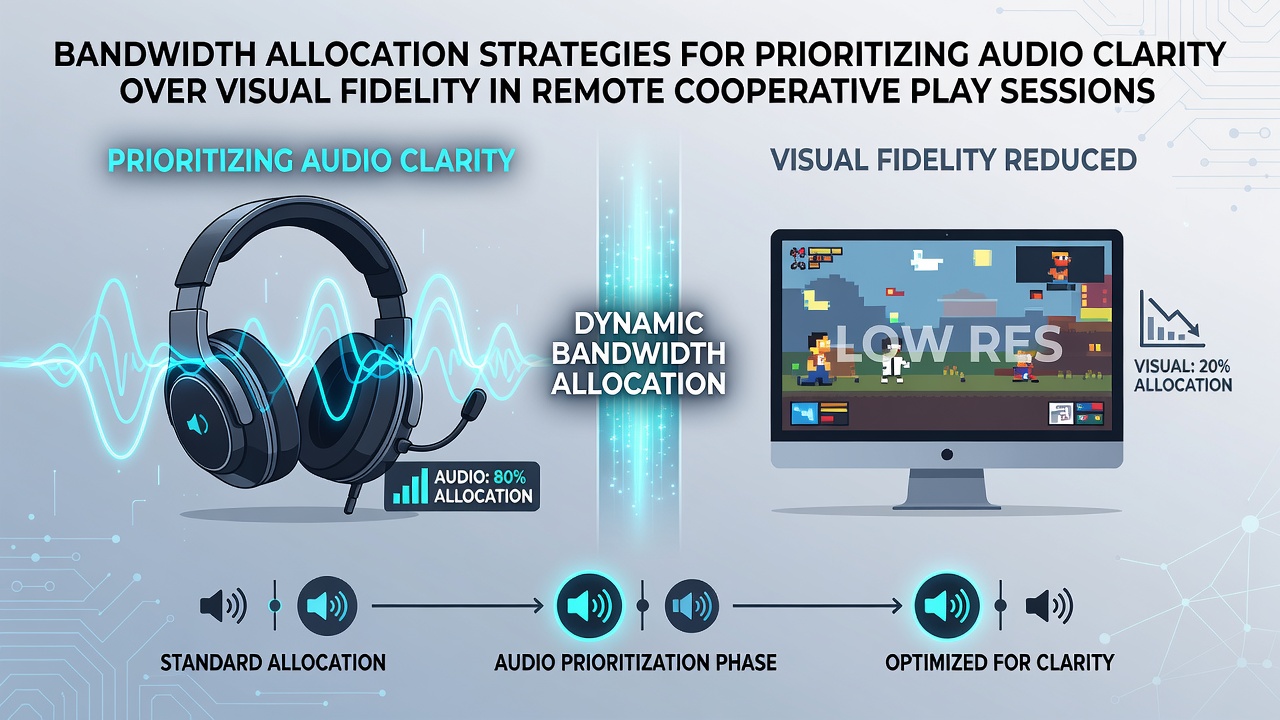
Bandwidth Allocation Strategies for Prioritizing Audio Clarity Over Visual Fidelity in Remote Cooperative Play Sessions
Remote cooperative play sessions rely on stable connections where teams coordinate through voice chat and game audio cues while visuals take a secondary role during critical moments, and bandwidth allocation strategies have evolved to meet these demands by adjusting codec priorities and packet scheduling in real time.
Network engineers apply quality of service rules that reserve minimum throughput for audio streams using protocols such as Opus and AAC, which maintain intelligibility even when total available bandwidth drops below 10 megabits per second, whereas video feeds from game engines receive variable bitrates that scale down during congestion without interrupting positional sound information essential for team synchronization.
Core Technical Approaches
Adaptive bitrate algorithms monitor round-trip latency and jitter before reallocating resources, so audio packets receive expedited forwarding while video frames enter lower-priority queues, and this separation becomes especially relevant when multiple players share a single upstream connection during extended matches.
Researchers at academic institutions have documented how dynamic range compression combined with forward error correction protects spoken communication against packet loss rates up to 15 percent, whereas visual fidelity can tolerate greater degradation because players often rely on spatial audio cues rather than high-resolution textures for navigation and timing decisions.
Implementation in Current Ecosystems
Streaming software packages allow users to configure separate encoder instances, one dedicated to voice channels and another handling gameplay footage, which permits independent bitrate caps that favor the former during peak load periods, and router firmware updates released in late 2025 introduced finer-grained traffic shaping rules that recognize game-specific audio ports and assign them higher DSCP markings.
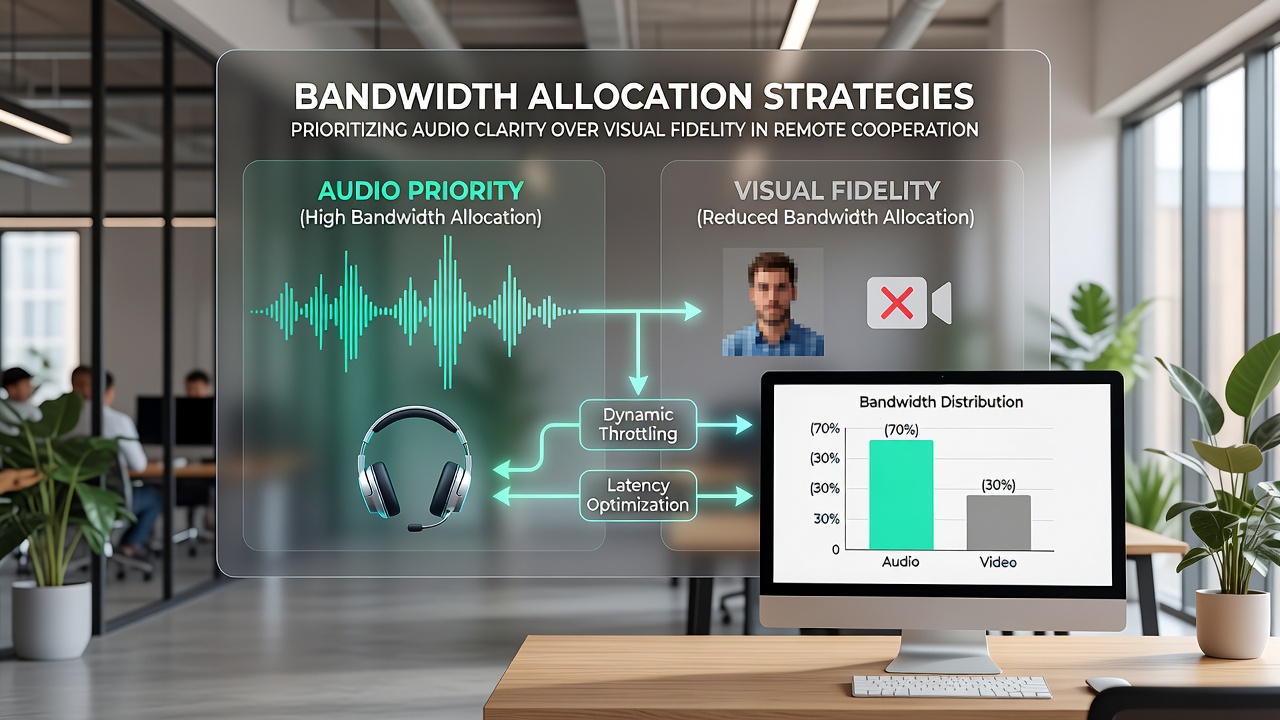
In November 2026 several major titles introduced native support for layered audio transmission that decouples dialogue tracks from ambient soundscapes, allowing servers to transmit only essential voice data when overall bandwidth contracts, and industry reports from the Entertainment Software Association indicate cooperative genres now account for over 40 percent of online multiplayer hours tracked across North American platforms.
European Telecommunications Standards Institute guidelines recommend reserving at least 128 kilobits per second per active voice channel in shared environments, which leaves remaining capacity for reduced-resolution video that still conveys basic movement information without competing for the same transmission windows.
Measurement and Adjustment Techniques
Continuous monitoring tools collect per-packet statistics and feed them into machine learning models that predict congestion windows seconds ahead, enabling preemptive downscaling of video resolution while audio sample rates remain locked at 48 kilohertz, and case studies from university labs show this method reduces voice dropouts by measurable margins compared with uniform bitrate distribution.
Players often discover that enabling hardware-accelerated audio processing on client devices further reduces CPU overhead on the encoding side, freeing cycles for more aggressive video compression when conditions require it, and similar patterns appear across different geographic regions where infrastructure varies widely.
Conclusion
Effective bandwidth allocation in remote cooperative sessions hinges on clear separation between audio and video pathways combined with responsive adjustment mechanisms that protect communication integrity first, and ongoing refinements in codec efficiency plus router capabilities continue to support these priorities as participation in team-based online play expands globally.